BeliefPPG
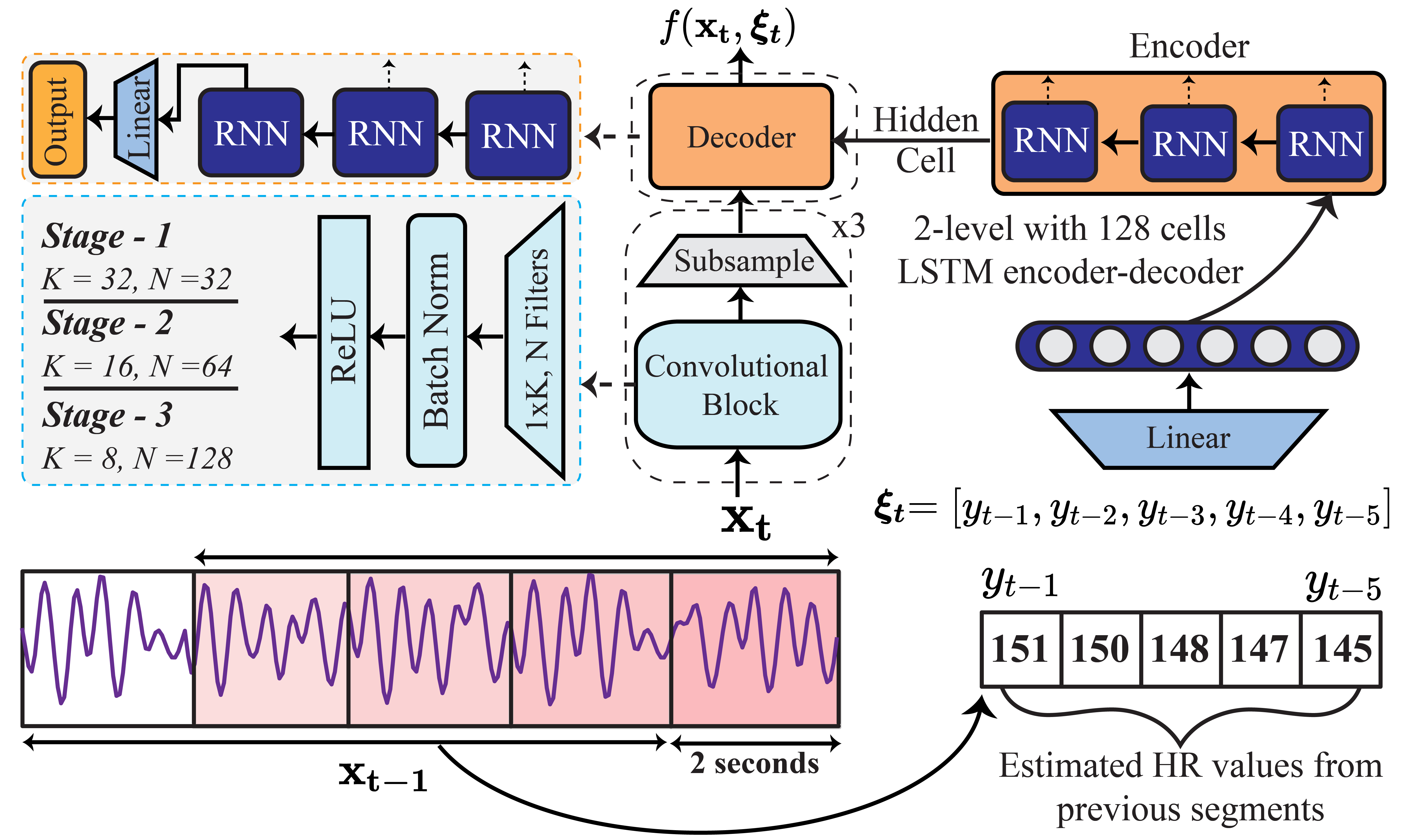
The oscillations of the human heart rate are inherently complex and non-linear—they are best described by mathematical chaos, and they present a challenge when applied to the practical domain of cardiovascular health monitoring in everyday life. In this work, we study the non-linear chaotic behavior of heart rate through mutual information and introduce a novel approach for enhancing heart rate estimation in real-life conditions. Our proposed approach not only explains and handles the non-linear temporal complexity from a mathematical perspective but also improves the deep learning solutions when combined with them. We validate our proposed method on four established datasets from real-life scenarios and compare its performance with existing algorithms thoroughly with extensive ablation experiments. Our results demonstrate a substantial improvement, up to 40%, of the proposed approach in estimating heart rate compared to traditional methods and existing machine-learning techniques while reducing the reliance on multiple sensing modalities and eliminating the need for post-processing steps.
Berken Utku Demirel and Christian Holz. Temporal Cardiovascular Dynamics for Improved PPG-Based Heart Rate Estimation. In Journal of Biomedical and Health Informatics 2025 (IEEE JBHI).