Sensing Posture-Aware Pen+Touch Interaction on Tablets
For more than two decades, capacitive sensing has played a prominent role in human-computer interaction research. Capacitive sensing has become ubiquitous on mobile, wearable, and stationary devices—enabling fundamentally new interaction techniques on, above, and around them. The research community has also enabled human position estimation and whole-body gestural interaction in instrumented environments. However, the broad field of capacitive sensing research has become fragmented by different approaches and terminology used across the various domains. This paper strives to unify the field by advocating consistent terminology and proposing a new taxonomy to classify capacitive sensing approaches. Our extensive survey provides an analysis and review of past research and identifies challenges for future work. We aim to create a common understanding within the field of human-computer interaction, for researchers and practitioners alike, and to stimulate and facilitate future research in capacitive sensing.
Tobias Grosse-Puppendahl, Christian Holz, Gabe Cohn, Raphael Wimmer, Oskar Bechtold, Steven Hodges, Matt Reynolds, and Joshua Smith. Finding Common Ground: A Survey of Capacitive Sensing in Human-Computer Interaction. In Proceedings of ACM CHI 2017.
@inproceedings{grossepuppendahl2017capacitivesensingsurvey, author = {Grosse-Puppendahl, Tobias and Holz, Christian and Cohn, Gabe and Wimmer, Raphael and Bechtold, Oskar and Hodges, Steve and Reynolds, Matthew S. and Smith, Joshua R.}, title = {Finding Common Ground: A Survey of Capacitive Sensing in Human-Computer Interaction}, year = {2017}, isbn = {9781450346559}, publisher = {Association for Computing Machinery}, address = {New York, NY, USA}, url = {https://doi.org/10.1145/3025453.3025808}, doi = {10.1145/3025453.3025808}, booktitle = {Proceedings of the 2017 CHI Conference on Human Factors in Computing Systems}, pages = {3293–3315}, numpages = {23}, location = {Denver, Colorado, USA}, series = {CHI '17} }
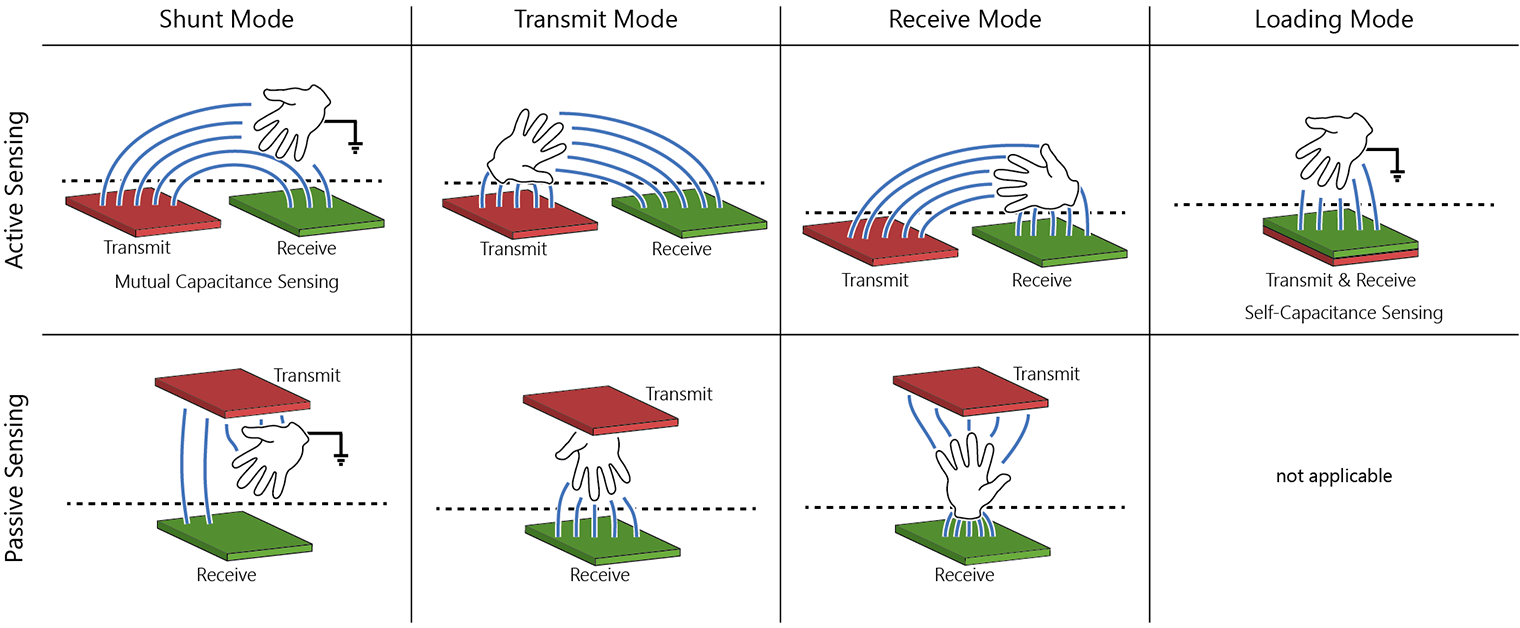
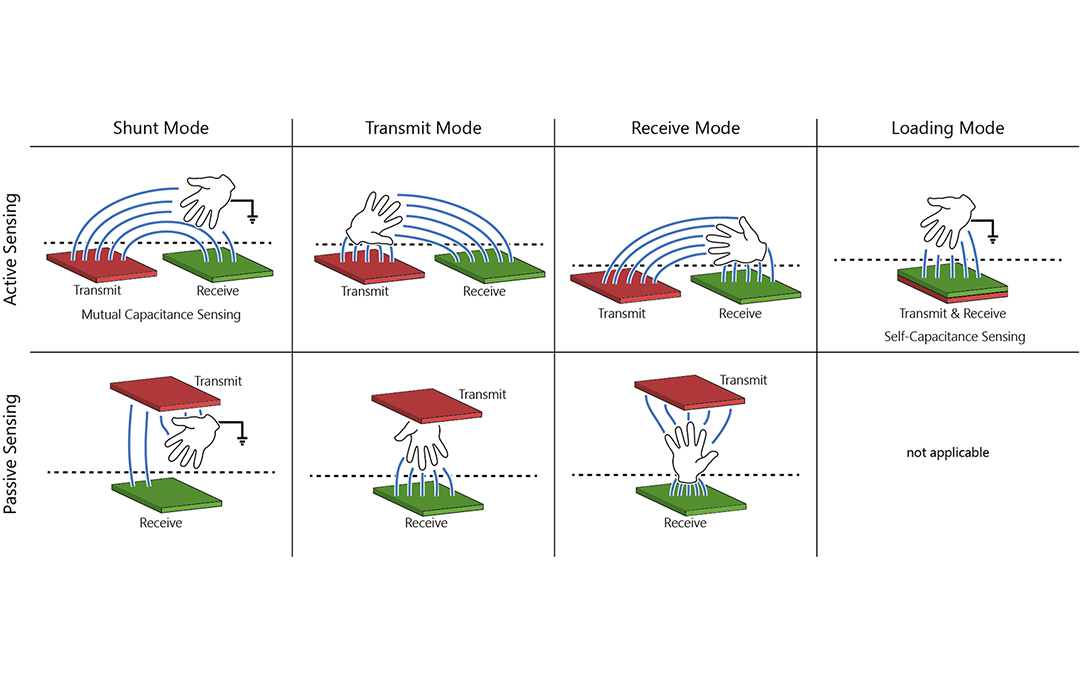
Capacitive sensing techniques can be divided into four operating modes: shunt, transmit, receive, and loading. Except for loading mode, each mode may be implemented using active or passive sensing. The dashed line represents the boundary between the sensing system (bottom) and the environment (top).
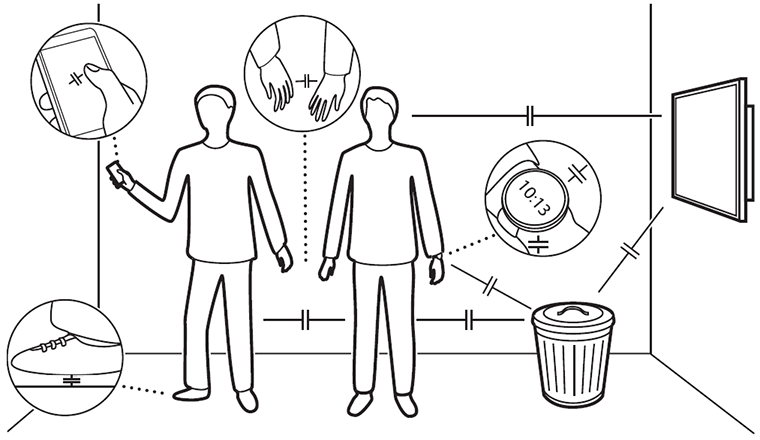
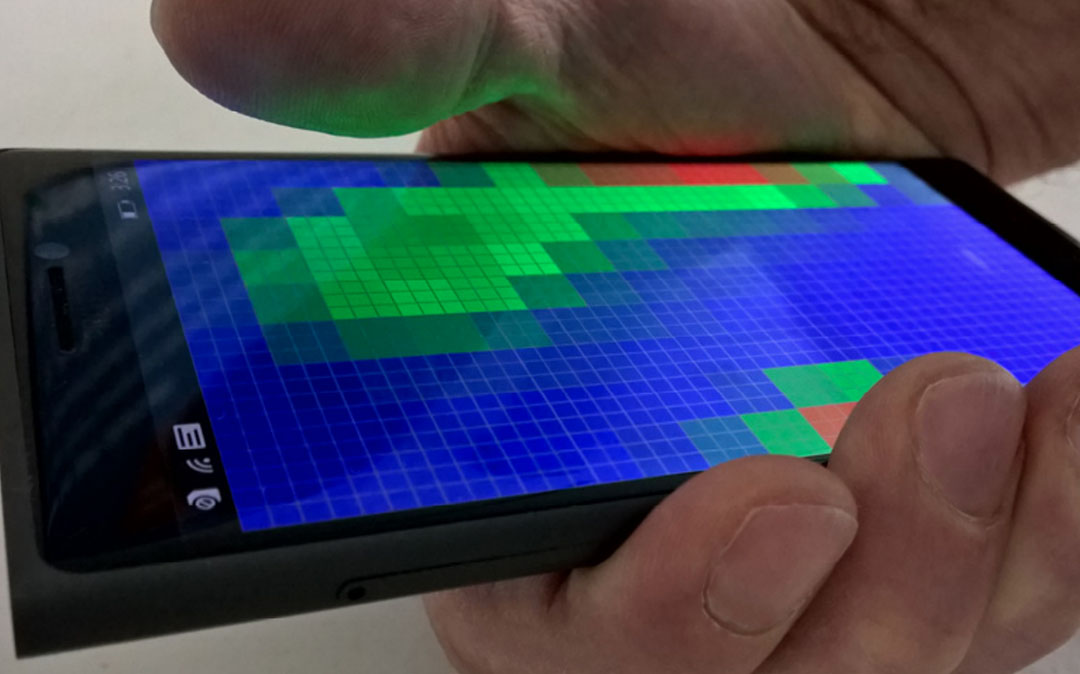
Figure 1. Capacitance naturally exists between people, their devices, and conductive objects in the environment. By measuring it, capacitive sensors can infer the position and proximity of users and other objects, supporting a range of different applications. However, this inherent capacitive coupling between objects also increases ambiguity of sensor readings and adds noise.
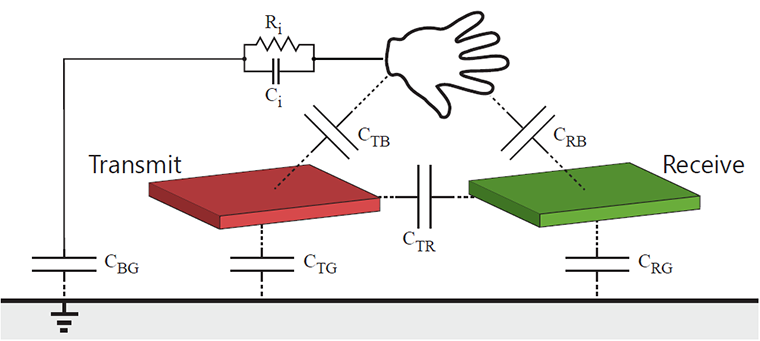
Figure 2. Lumped circuit model of capacitive sensing as introduced by Smith et al. [186]. Depending on the sensing mode, different capacitances are controlled or measured.