EgoPHI
Augmenting the surface of 3D objects with capacitive sensing is particularly challenging when their volumes cannot be modified. In this paper, we present a generative computational fabrication pipeline that retrofits surface-only sensor layouts to 3D geometries for multi-touch interaction. Our system scans real-world objects to obtain their 3D mesh, generates and optimizes a 3D sensor design of drive and sense lines for mutual-capacitance sensing that complies with physical and hardware sensing constraints, and unfolds them into individual 2D stencils that can be cut from conductive material. Our fabrication pipeline cuts these from thin copper foil with a vinyl cutter and then assists manual sensor attachment by projecting the sensor design onto the dynamically registered real-world object. We connect the resulting electrode mesh to a mutual-capacitance scanning controller and resolve touch interaction in real time. We demonstrate our approach with four 3D geometries and evaluate our method and fabrication pipeline on them.
Andela Ilic, Junpeng Gao, Zhipeng Li, Yijing Jiang, Rachel Schuchert, Manuel Meier, Philipp Herholz, and Christian Holz. Retrofitting Existing 3D Objects with Surface-Conforming Capacitive Sensing. In Proceedings of ACM SIGGRAPH 2026.
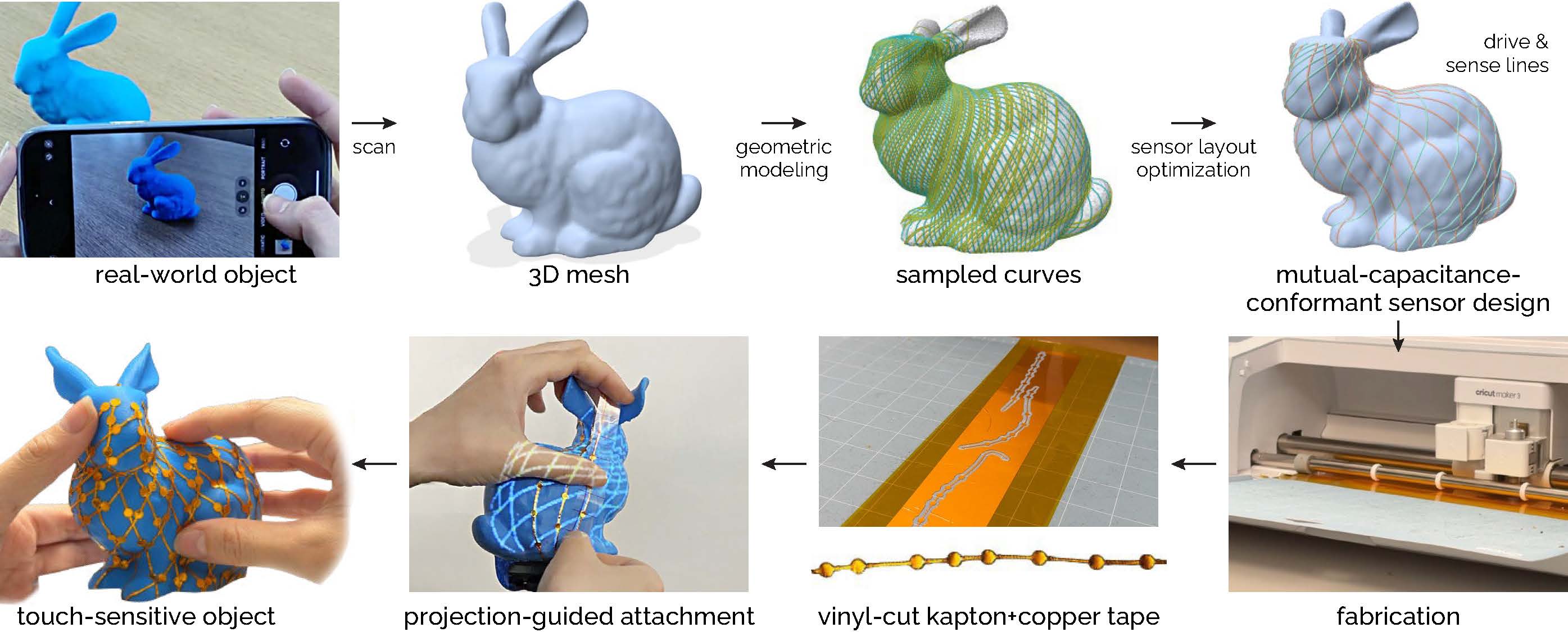
Figure 2. Our computational fabrication pipeline comprises real-world object scanning, 3D sensor layout generation, optimization for hardware constraints and sensor surface coverage, conductor fabrication, projection-guided sensor attachment, and interactive touch sensing and visualization.
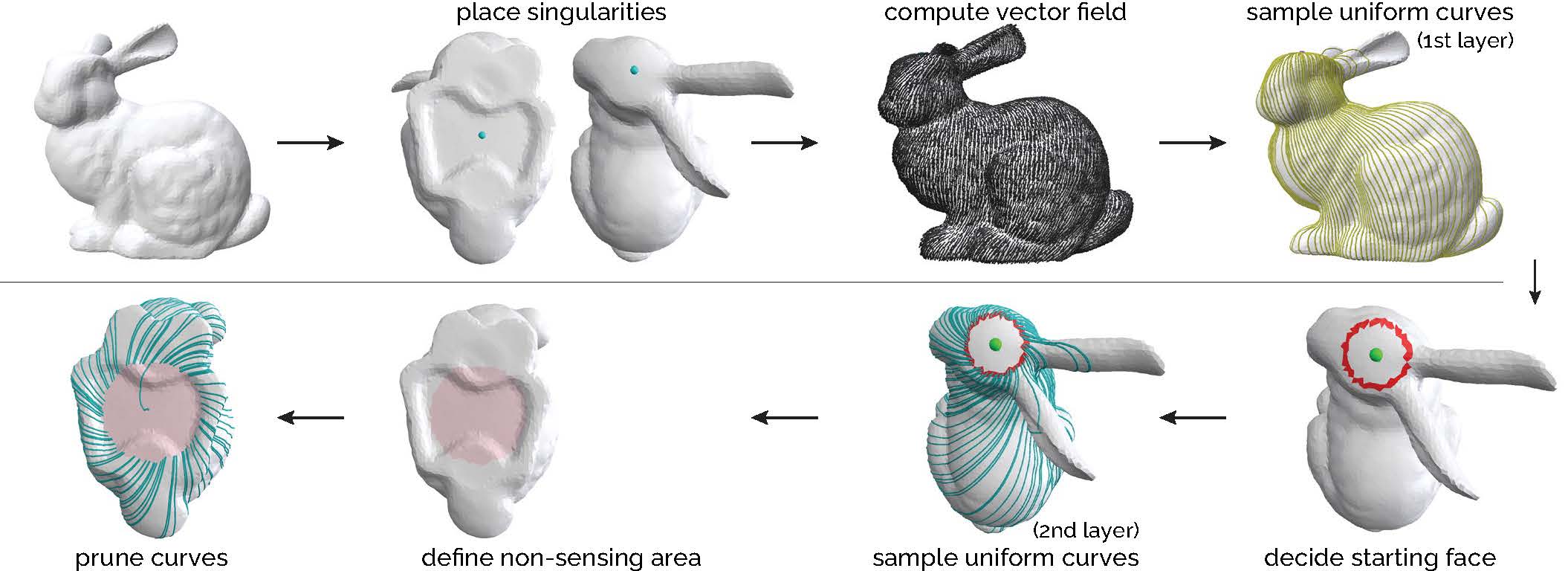
Figure 3. The curve layout is sampled as follows. For a 3D mesh, we first place singularities in non-sensing regions of the surface (e.g., the bunny’s base and head). Next, we compute a vector field and uniformly sample the first layer of curves. We then select starting faces for the second layer and sample curves at different angles. Finally, we refine the non-sensing regions and trim the curves at their boundaries.
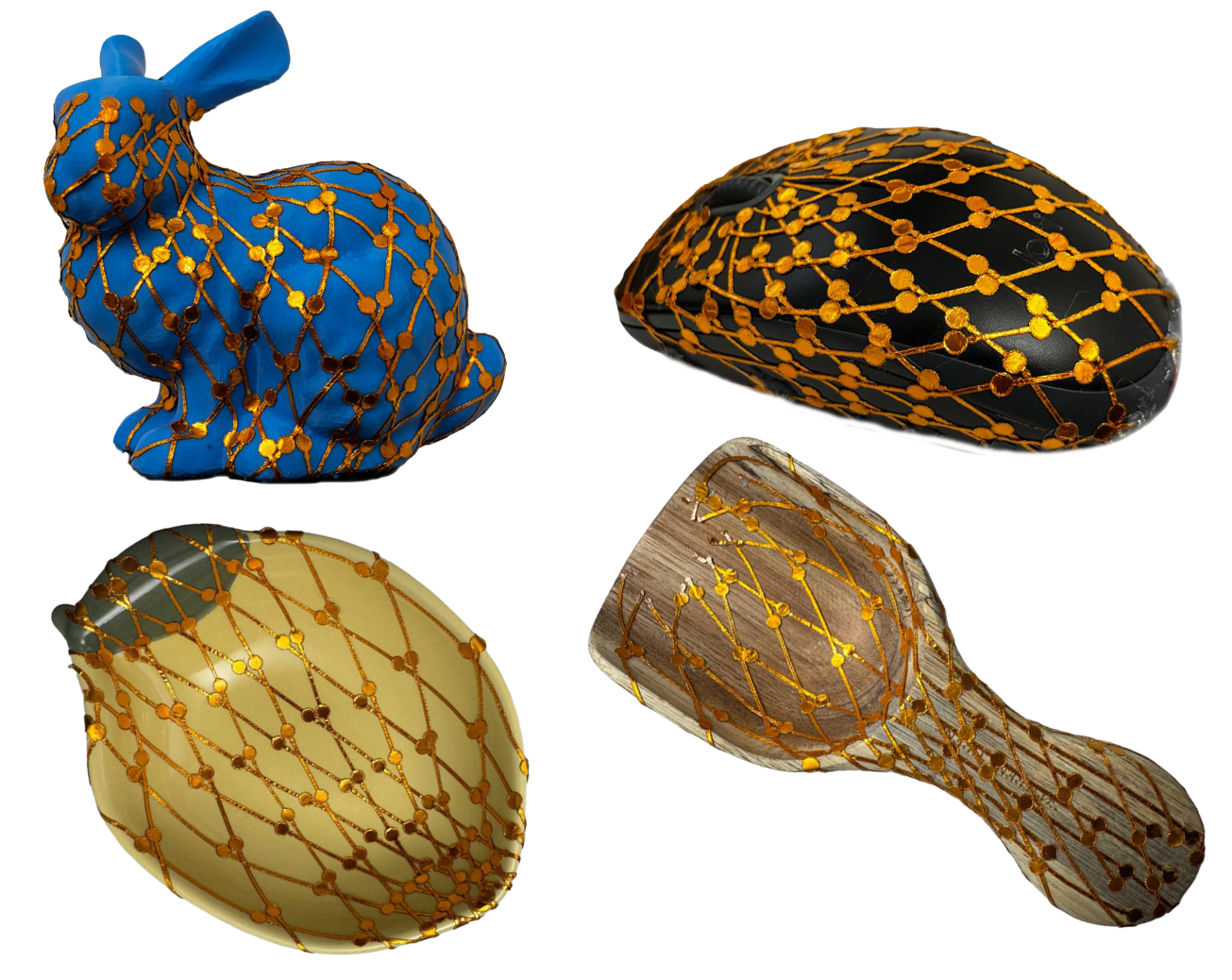
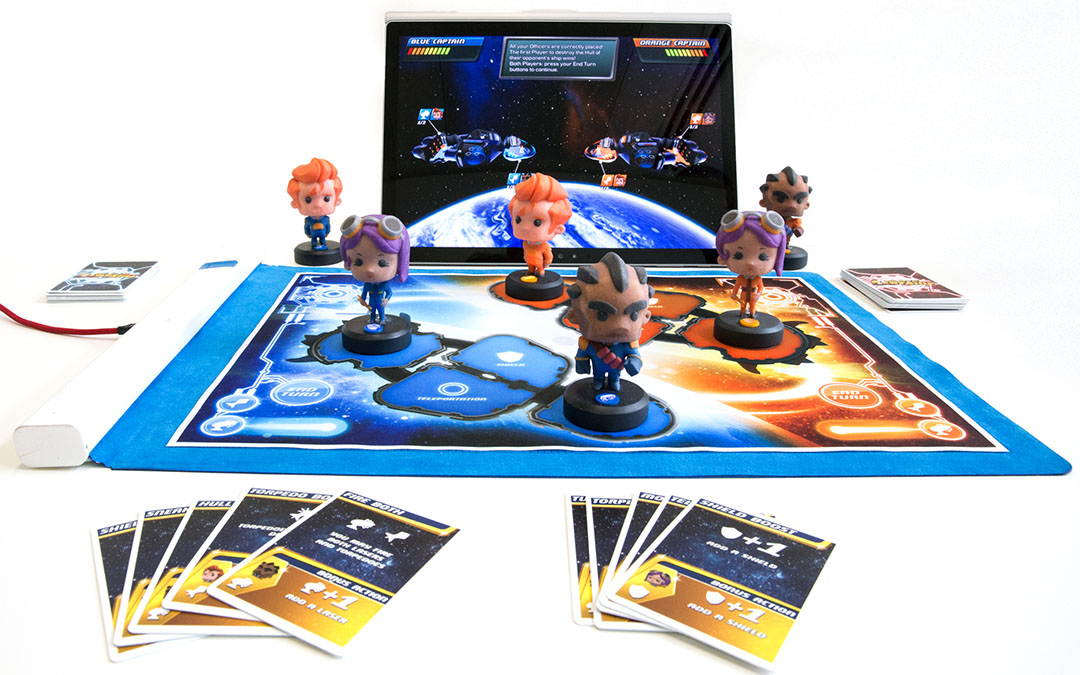
Figure 4. Four touch-sensitive demonstrators fabricated with our method.
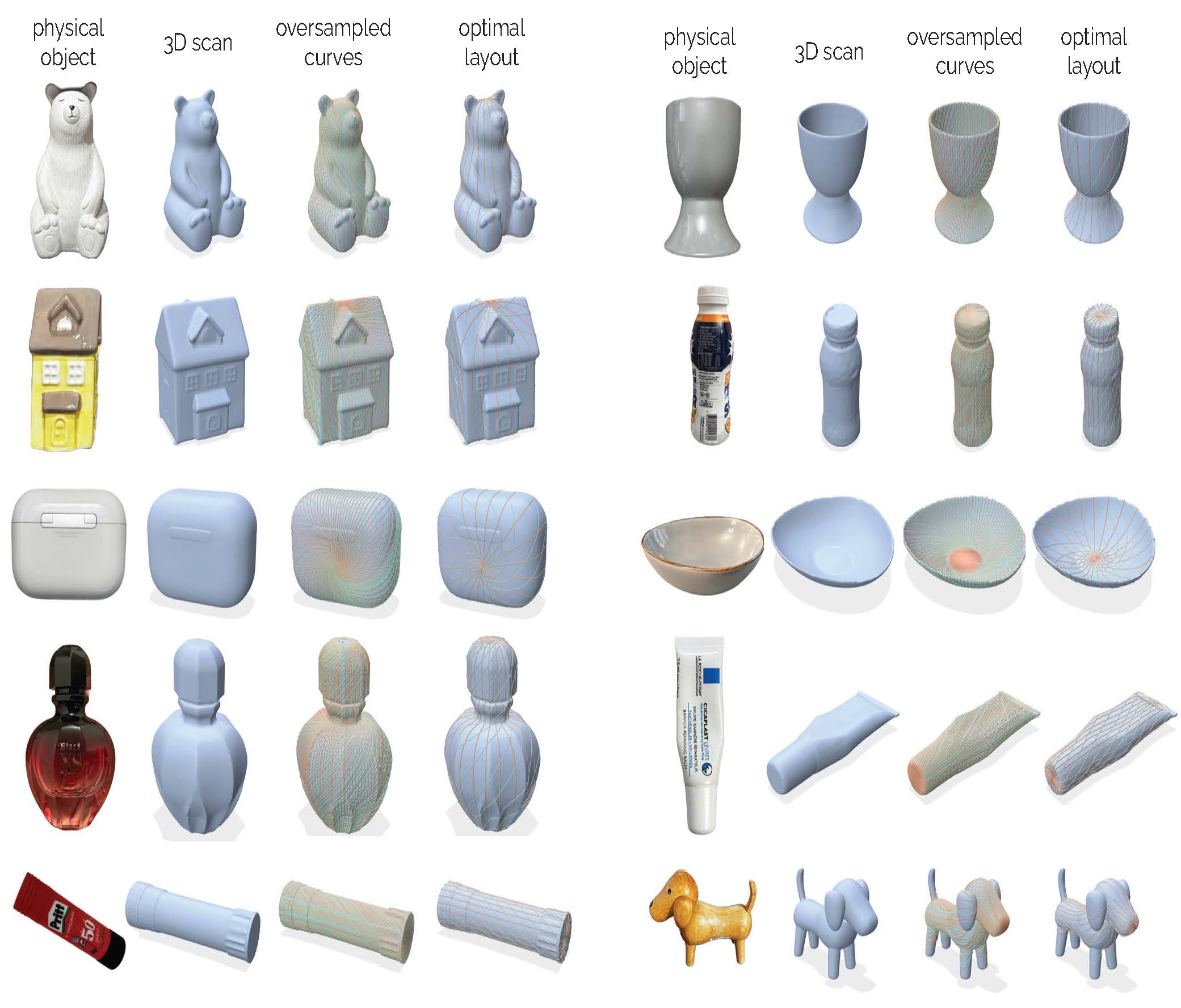
Figure 5. We apply our pipeline to ten additional existing physical objects without fabrication. For each object, we present photographs of the physical object, its 3D scan, oversampled intrinsic curves, and the corresponding optimization results.