Ultra Diffusion Poser
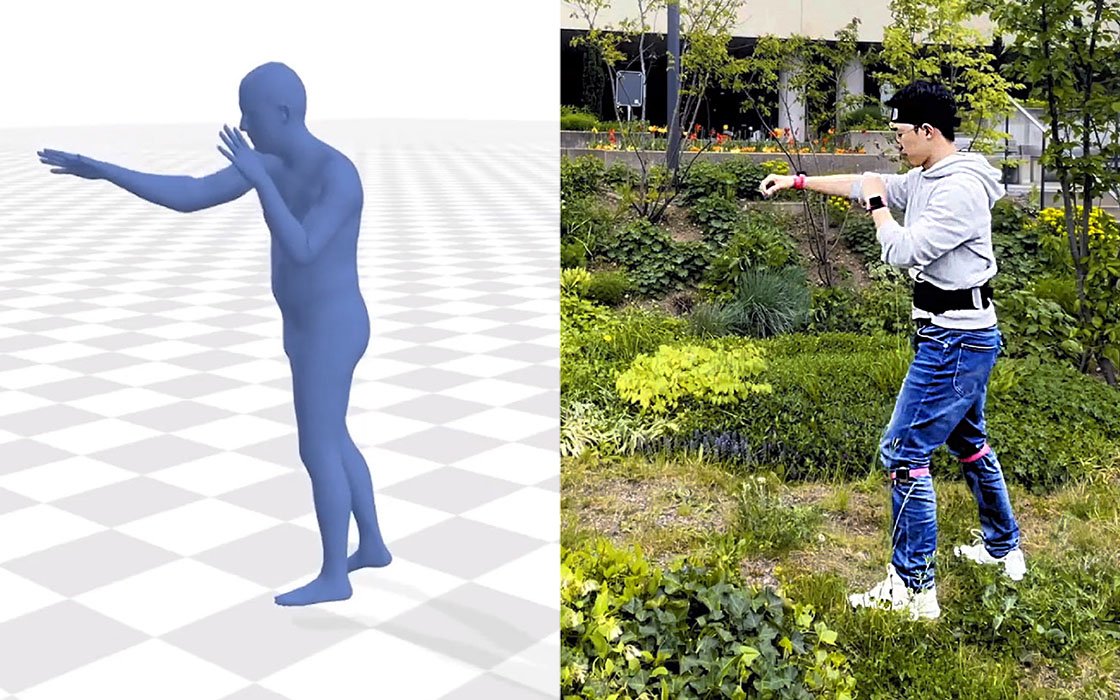
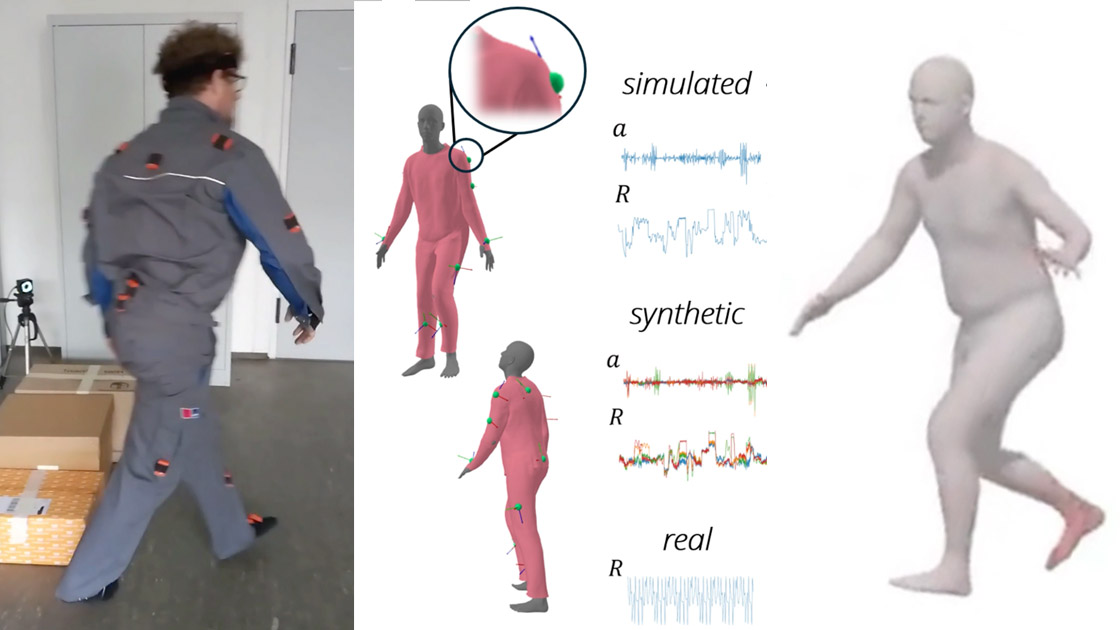
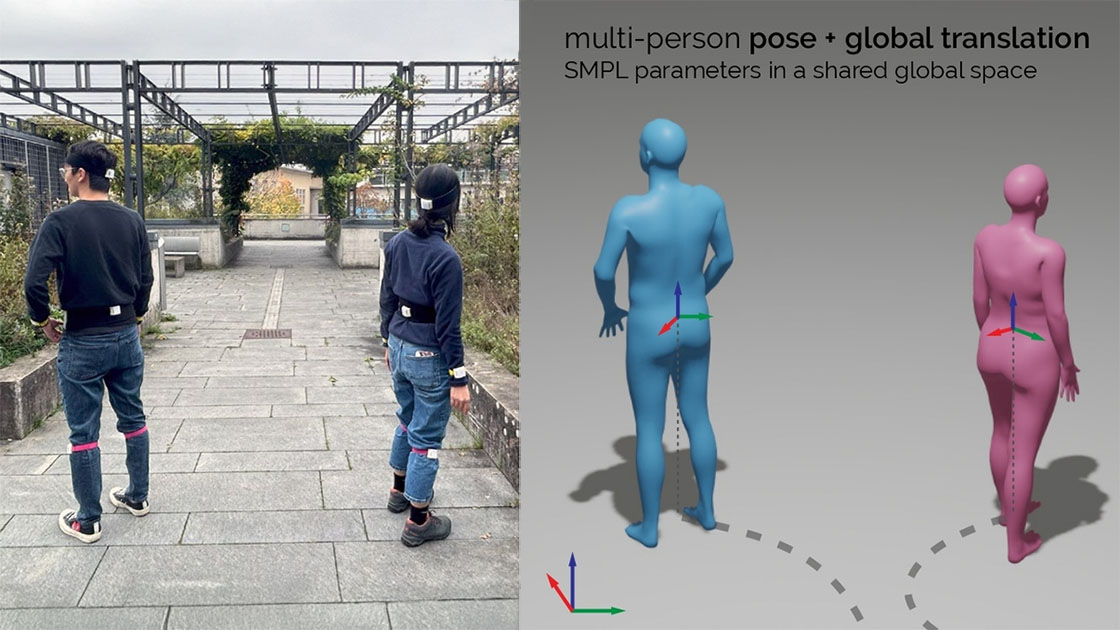
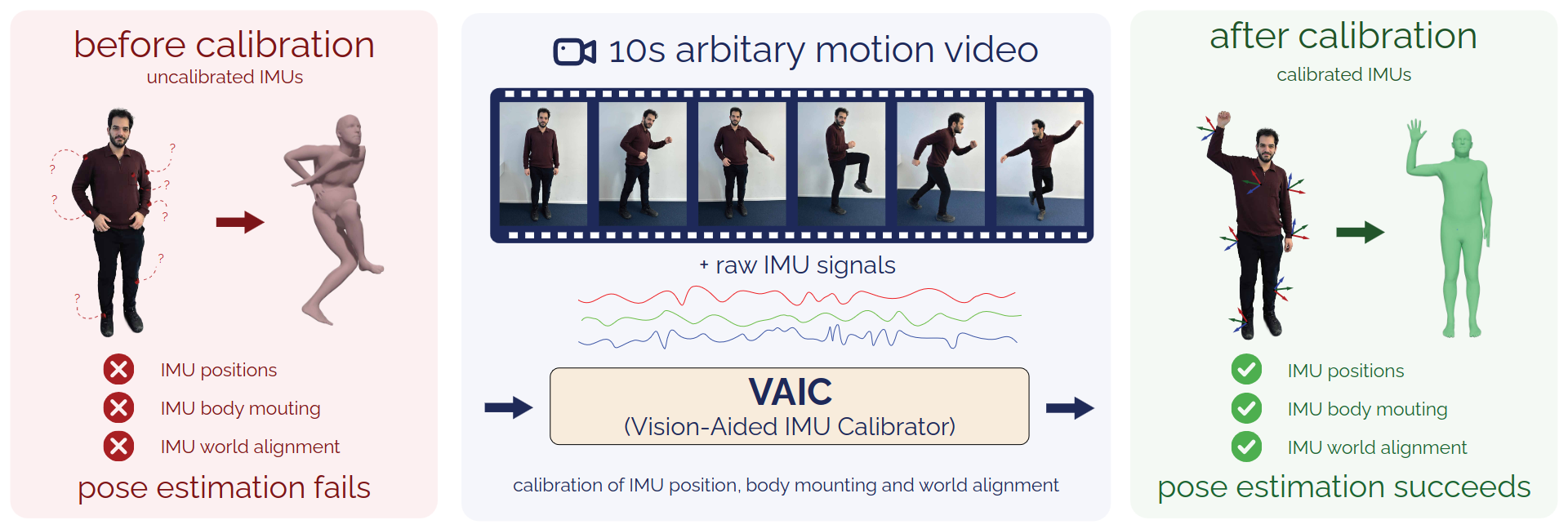
Inertial motion capture depends on expressing each IMU’s orientations and accelerations in a shared world frame and knowing how each sensor is rotated relative to the body segment it is attached to. However, in practice, this requires careful placement and manual calibration routines (T-pose) that do not scale to arbitrary sensor sets or in-the-wild use. We present VAIC, a visual–inertial calibration method that uses a few seconds of monocular video of arbitrary user motion plus uncalibrated IMU streams to jointly recover (1) each sensor’s body location (as a vertex on an SMPL mesh), (2) its sensor-to-body mounting rotation, and (3) the global reference alignment to the world frame. Our method operates without predefined poses, fixed sensor configurations, or pre-calibrated hardware. Instead, we treat calibration as an optimization problem: from video-based SMPL recovery, VAIC searches for the sensor-to-vertex alignment that best explains the measured IMU signals given these vertex kinematics.
Evaluated on TotalCapture (13 IMUs), VAIC localizes sensors with 95.9% correct bone assignment and 5.8 cm positional RMSE (97.9% and 5.1 cm when excluding low-excitation motions), and achieves up to 15.5° end-to-end orientation error, which outperforms all classical calibration methods such as T-pose or walking-based calibration. When sensor positions are known, VAIC improves over T-pose calibration, reduces body-mounting error by 5.3°, and lowers overall body-orientation error. These results suggest a practical path toward plug-and-play inertial motion capture, providing reliable cold-start calibration that can also initialize or complement downstream continuous tracking systems.
Dominik Hollidt and Christian Holz. Vision-Aided IMU Calibrator: Robust On-body IMU Calibration from a Single Video. In Proceedings of ACM SIGGRAPH Asia 2026 (SIGGRAPH Asia).
@inproceedings{hollidt2026vaic, title={Vision-Aided IMU Calibrator: Robust On-body IMU Calibration from a Single Video}, author={Hollidt, Dominik and Holz, Christian}, booktitle={SIGGRAPH Asia 2026 Conference Papers}, year={2026}, doi={10.1145/3829340.3842338} }
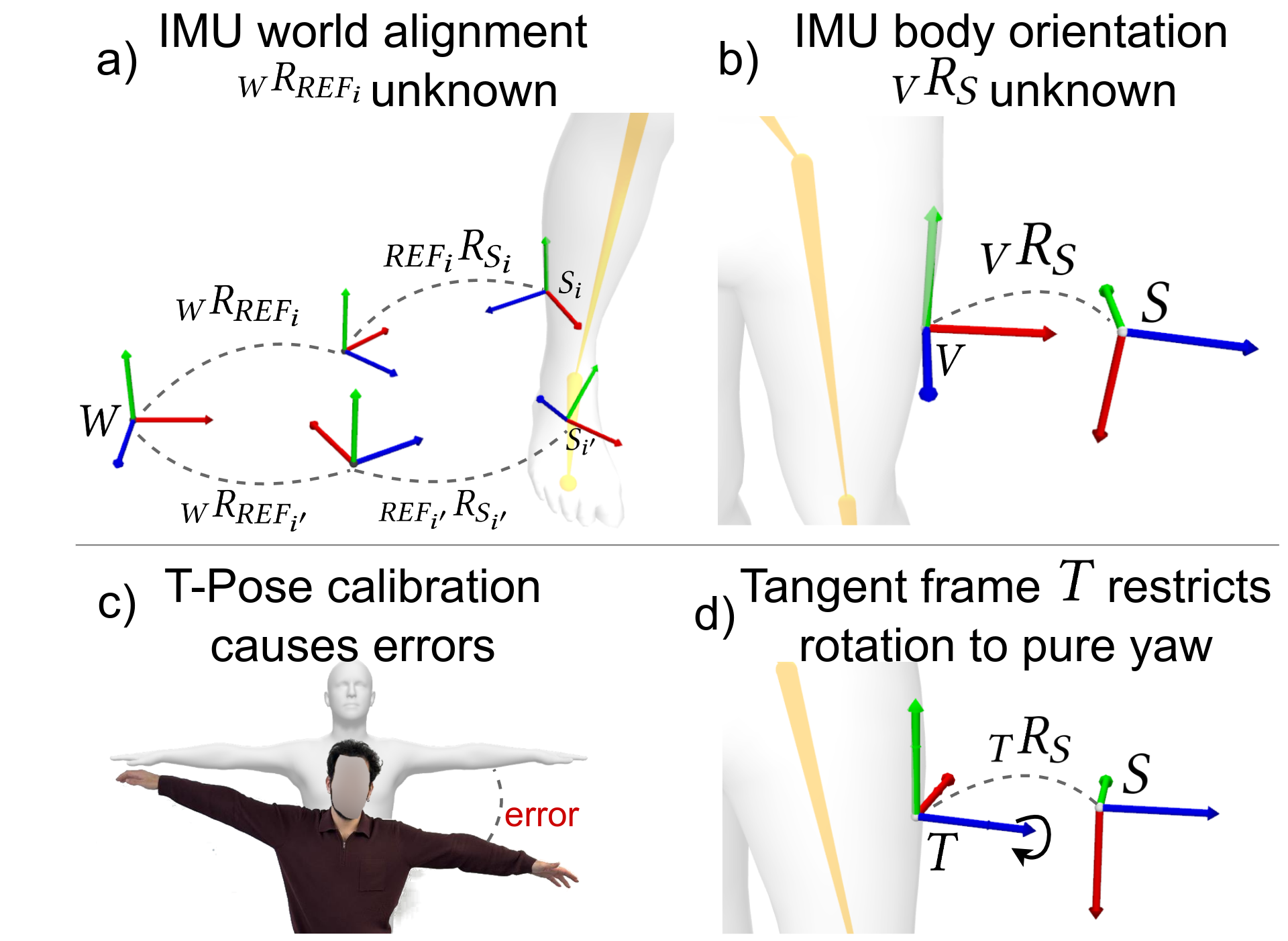
Figure 2: The IMU world alignment and the IMU body mounting are unknown. Static T-pose calibration causes calibration errors and cannot recover the world alignment. VAIC introduces the surface tangent frame T that constrains the sensor orientation to pure yaw to improve calibration.
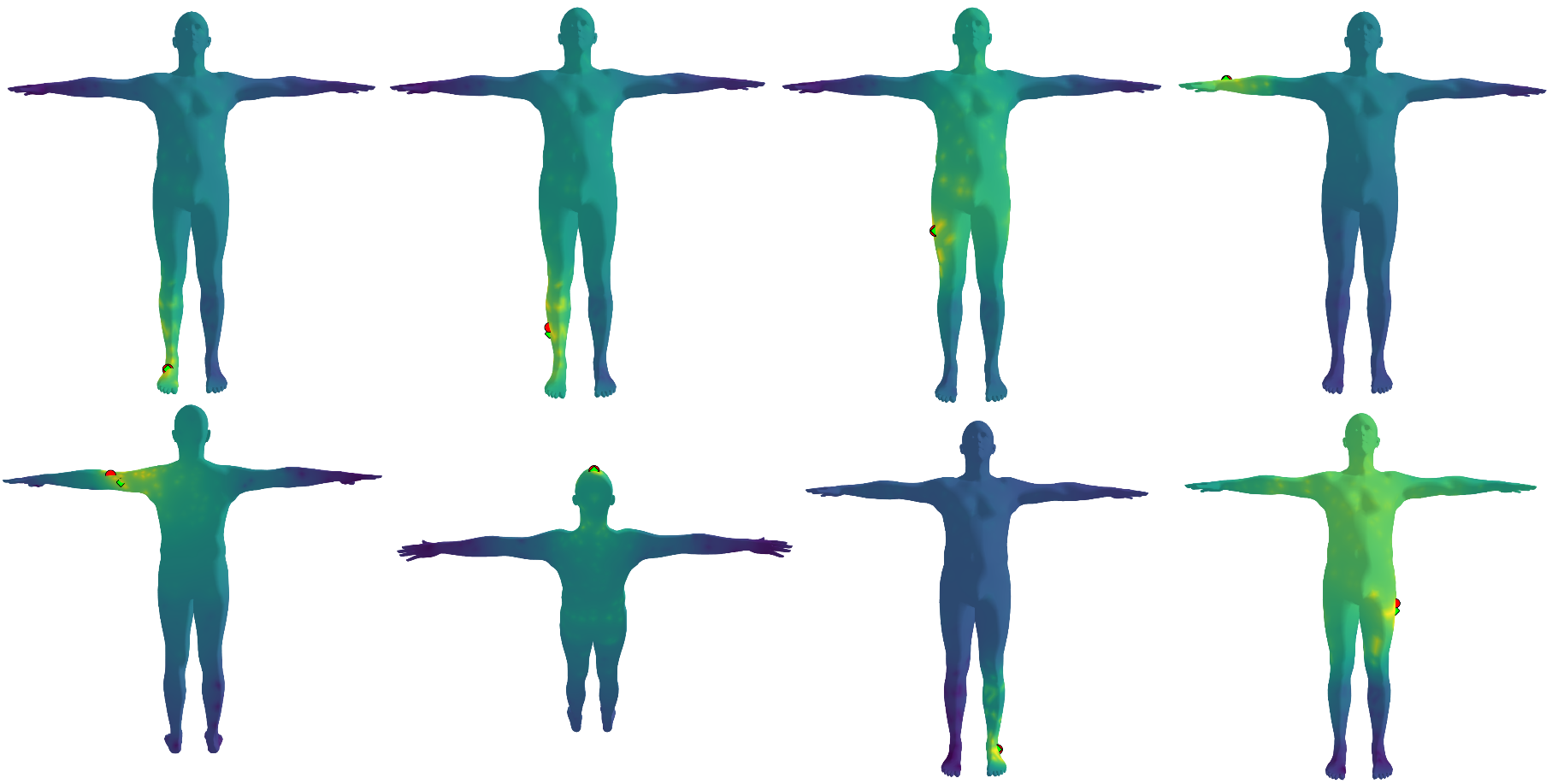
Figure 3: Localization results of VAIC on a 20 s walking calibration sequence. VAIC accurately recovers the positions of uncalibrated IMUs on the body. Red circles indicate predicted positions, and green diamonds show ground truth. Brighter colors indicate a higher matching score between the IMU and the vertex. It is generally seen that vertices on the same body part have higher match scores. The correct localization on that body part is aided by the normal error that models the sensor lying flat on the body.
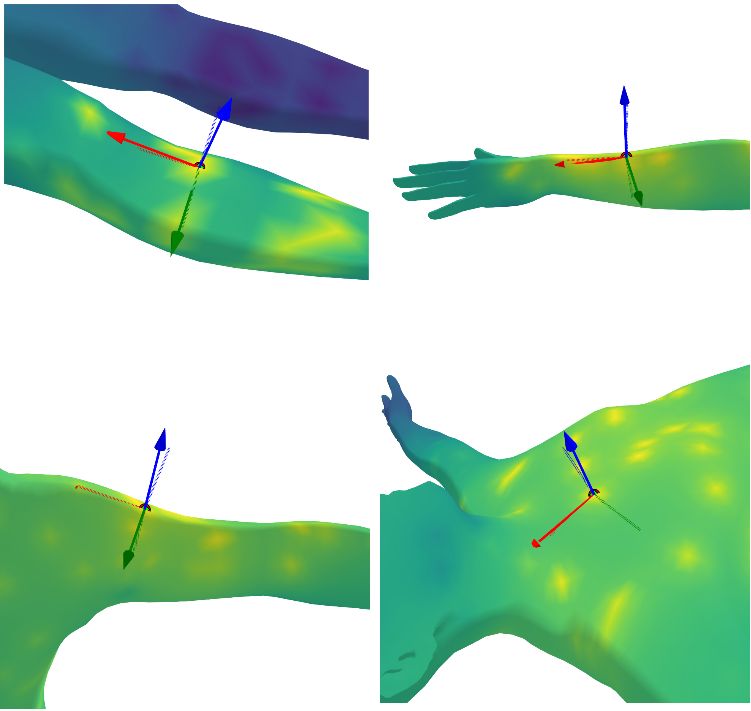
Figure 4: Visualization of different body-mounting calibration results of VAIC. VAIC generates accurate calibration results. Dashed lines indicate the predicted frame, solid lines the ground truth frame.